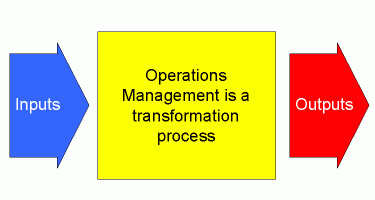
Operation Management
Operation Management Glossary:
This glossary includes terms pertinent to operations management. It was compiled to assist operations management students in courses at the University of Michigan Business School. Also it could be very helpful for anyone that want to learn about OM
ABSENTEE POLICY:
The policy that covers allowed absence from the workplace and the penalties that accrue for excessive absence. This policy is typically part of the employee handbook.
ACCOUNTS PAYABLE:
Liabilities that result from a purchase of goods or services on an open account. Amounts owed to suppliers of goods or services.
ACCOUNTS RECEIVABLE:
Amounts owed to a company by customers as a result of delivering goods or services and extending credit in the ordinary course of business.
ACQUISITION:
Typically the purchase of a company or a significant business asset. In the defense industry, acquisition means the purchase of products and systems.
ACTIVITY:
Generally the processing at a work station or equipment location
AGGREGATION:
The concept indicating that pooling of demand or other random variables reduces the variance of the resulting aggregated variable.
ALLOCATION:
The assignment of costs incurred in one area or function of a plant or company to another because of the service to the charged unit.
ASSETS:
The tangible and intangible goods, intellectual property, and goodwill that are listed under the asset column in the balance sheet for a company. Any beneficial item owned by a company.
ATTRIBUTE:
A critical property of an activity or operation
AVAILABILITY:
That time or percentage of time that a resource unit or activity center is ready to process or be activated.
BENCHMARKING:
Benchmarking is defined as a process of continuous comparison of a company’s performance on predetermined measure against that of the best in an industry or a class, considered the standard or the reference. Benchmarking is one of the most popular business management tools for establishing competitive advantage and initiating performance improvements. The Benchmarking process supports the adoption of best practices with enhanced organization performance. The goal is to attain low-cost producer status. BENEFITS:
BEST PRACTICE:
Denotes that practice considered the most effective for an industry. Best practices continually evolve. Best practices are often assessed across industries to set new "best practice" standards.
BILL OF MATERIAL (BoM):
A bill of material is an ordered listing of all the parts in a finished product. The listing usually includes the part number, how many of each part is required, and a brief word description of the part. It is best practice to use only words that appear in a parts dictionary. Bills of material are usually organized by indenting subsystems.
BUILDING TO CUSTOMER ORDER versus BUILDING TO FORECAST:
Building to customer order means that at least the final assembly, packaging, and shipping awaits a firm order for the product. Building to forecast means that the product is manufactured to a forecasted demand. Building to customer order means that the product is pulled by customer order rather than pushed by a forecast.
CRITICAL PATH:
That path through a process or activity system that has the longest theoretical flow time
DEMAND:
Customer requirements measured in production or sales per unit time
FLOW TIME:
The average (actual) time for a unit of production to flow through a process unit or activity including input and output inventories. Theoretical Flow Time is the flow time without inventories.
FORECAST:
Usually the prediction of customer sales and the subsequent manufacturing schedule
INPUTS:
The material or products that are presented or flow into an activity.
OPERATIONS:
Any activity that transforms and adds value to an input stream. The input stream can be a physical entities, services, or flows. The valued added transformation produces products or services that are designed to meet a customer demand. Operations range from processing loan applications to production of computers, to designing buildings
PURCHASING:
That function that defines the conditions that govern purchases within a company as well as the actual purchase of the goods and services.
SCHEDULE:
Ordering of production to meet forecasted or actual customer demand.
SERVICE OPERATION:
Operations in a service industry or business. Such businesses are generally characterized by direct service to consumers rather than in the supply of manufactured products. As traditional manufacturing businesses have become more customer oriented and service businesses more product focused, such differentiation has blurred. Examples of service businesses are restaurants, banks, health care, and education.